
TL;DR: Most swim school software includes hundreds of features you’ll never use, yet you’re paying for all of them. The real cost isn’t the subscription price. Organisations waste 20% of their software budgets on underused tools. Unused features create training overhead, decision fatigue, and endless workarounds. Purpose-built software costs less because it does less, but what it does fits your operation perfectly.
What You Need to Know About Software Features
• 80% of software features are rarely or never used
• Unused features cost you in training time, support delays, and workarounds
• Generic platforms serve multiple industries, so they can’t specialise deeply
• Purpose-built software makes industry-specific operations the default, not a configuration project
• The best software evaluation asks “how does it do this?” instead of “can it do this?”
I watched a swim school owner show me their new software last month. They were excited about the features.
Inventory management. Point-of-sale for retail. Advanced marketing automation. Event ticketing.
They run swim lessons. That’s all.
When I asked which features they used, the answer was telling. Scheduling, billing, attendance tracking. The rest sat untouched.
They were paying for a department store when they needed a specialty shop.
Why Do Swim School Owners Choose Feature-Heavy Software?
Most swim school owners pick software by counting features. The platform with the longest list wins.
This makes sense on the surface. More features mean more value, right?
The data tells a different story.
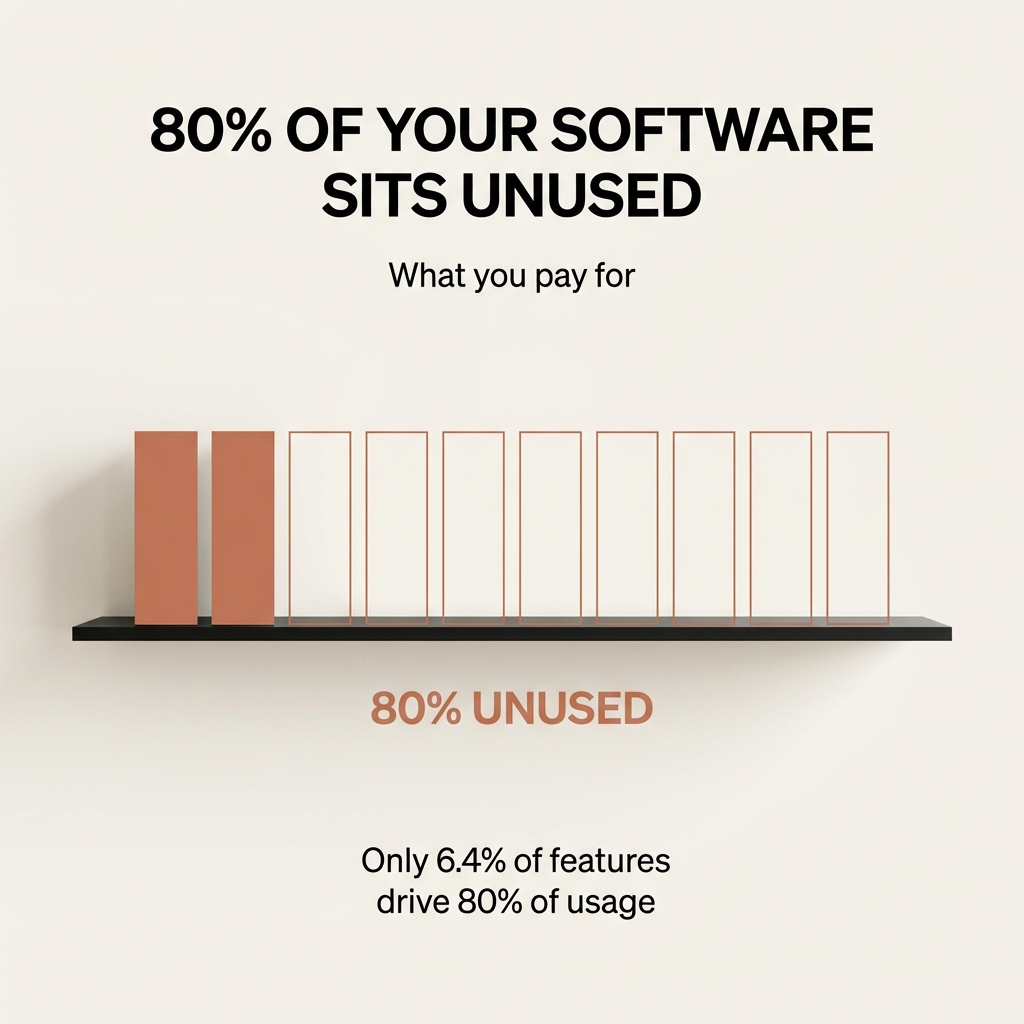
Feature adoption rates across software products average 6.4%. For every 100 features your team builds and ships, only 6.4 drive 80% of click volume.
Put another way: 80% of features in the average software product are rarely or never used.
You’re not paying for what you use. You’re paying for what exists.
Bottom line: Feature count is a poor indicator of software value because most features sit unused.
What Do Unused Features Cost You?
The subscription price is the beginning.
Organisations waste 20% of their software budgets on tools that are underused, poorly integrated, or never fully implemented.
The real cost shows up in three places most owners miss:
1. Training Time Multiplies
Every feature you don’t need is another thing your staff has to learn to ignore. Every menu option is another place they get lost.
I’ve seen front desk staff spend 10 minutes looking for the attendance screen because it was buried under retail inventory settings they’ll never touch.
2. Decision Fatigue Compounds
When you have 47 ways to configure class scheduling, you spend hours figuring out which approach fits your operation.
Generic platforms give you flexibility. What they don’t give you is clarity about which option works for swim schools.
3. Support Becomes Guesswork
When something breaks, the support team has to figure out which of 200 features you’re using and how you configured them.
I’ve watched this turn a 10-minute fix into a three-day ticket.
Employees lose nearly seven hours every week to complicated processes and fragmented tools. That’s a full workday spent fighting your software instead of running your business.
What this means for you: The hidden costs of unused features often exceed the subscription price because they drain time from your team every single day.
What Is the Workaround Tax?
Here’s what happens when you use generic software for specialised work.
A swim school needs makeup classes. A student misses their regular lesson, you offer them a spot in another class.
Simple concept. Swim-school-specific execution.
You need to track:
• Who’s owed a makeup
• When it expires
• Which classes have space
• Whether the student’s account is current
• How many makeups are blocking enrolment spots
Generic scheduling software doesn’t have this. So you build a workaround.
Maybe you use the “credit” system meant for retail refunds. Maybe you create fake appointment types. Maybe you track it in a spreadsheet.
Every workaround is a tax. You pay it in time, in errors, and in the mental overhead of remembering how you hacked the system to do what it should have done naturally.
How Workarounds Become Invisible
I ask new clients why they do certain things in their current software. After three or four “why” questions, the answer is the same.
“That’s how we’ve always done it.”
Translation: we built a workaround so long ago we forgot it was a workaround.
One centre ran their direct debit on the second Tuesday of every month. When we dug into why, it turned out that 10 years ago, their rent was due five days after that date.
The rent timing changed years ago. The direct debit schedule didn’t.
When we suggested weekly and fortnightly options that matched parent pay cycles, 65% of families switched within 10 weeks.
The workaround had become invisible. But it was still costing them.
The reality: Workarounds compound over time because you stop seeing them as problems and start seeing them as procedures.
When Do You Need Software? The 500-Student Breaking Point
Manual systems work until they don’t.
The breaking point for most swim schools is 500 students.
Below that number, you get by with spreadsheets, paper, and memory. You know most families by name. You track makeups in your head. Billing happens on a schedule you manage manually.
At 500 students, the system collapses.
You need a full-time admin person to manage what software should automate. Scheduling becomes a puzzle. Payment tracking becomes a liability. Communication becomes impossible to scale.
This is where most owners start shopping for software.
What Most Owners Get Wrong
The problem is they’re comparing the wrong things. They’re looking at feature lists when they should be looking at operational fit.
A platform built for swim schools handles the 500-student threshold differently than one built for general scheduling because:
• It assumes makeup classes exist
• It expects seasonal enrolment patterns
• It knows attendance tracking connects to billing in specific ways
Generic software makes you configure all of this. Purpose-built software makes it the default.
Here’s the difference: Generic software gives you tools to build a solution. Purpose-built software gives you the solution.
Why Generic Platforms Stay Generic
This isn’t about bad software companies. It’s about business models.
A platform serving multiple industries has to abstract away specificity. They can’t build deep swim school functionality because they also serve yoga studios, music schools, and tutoring centres.
Their incentive is breadth. Your need is depth.
Vertical software players are more profitable than horizontal software players. The median EBITDA margin is 15% for vertical versus 6% for horizontal.
The difference comes from focused product development and targeted marketing. Vertical companies spend 17% of revenue on sales and marketing. Horizontal vendors spend 34%.
When you serve everyone, you serve no one particularly well. When you serve one industry deeply, you can charge less and profit more because you’re not trying to be everything to everyone.
We’ve stayed focused on swim schools for 15 years. We’ve had requests to expand into other activities. We’ve turned them down.
The moment we start serving dance studios or martial arts schools, we stop understanding swim schools deeply enough to build software that feels like it was made for you.
Because it was.
What Purpose-Built Actually Means
Purpose-built doesn’t mean limited. It means intentional.
When we built makeup class management, we didn’t add a generic “credit system” and tell you to figure it out. We built visual tracking that shows which classes have makeup spots available. We added configurable expiry rules. We enabled parent self-booking with account balance checks.
These aren’t features you’d find on a comparison chart. They’re operational details that only matter if you actually run swim lessons.
The same applies to seasonal enrolment, skill-level progression, and attendance patterns that connect to billing cycles.
Generic platforms give you building blocks. Purpose-built platforms give you the building.
The Integration Illusion
All-in-one platforms promise to eliminate integration headaches.
In practice, they create different headaches.
The most requested integration we get is accounting software. Xero, MYOB, QuickBooks. It makes sense. You want your swim school revenue flowing into your accounting system automatically.
Here’s what we learned: the integration works fine. The problem is user understanding.
Small business owners don’t have accounting backgrounds. They struggle with control accounts and debtor reconciliation. The technical integration succeeds. The operational integration fails.
We’ve become more careful about which integrations we build. Payment processing is critical. Accounting is complicated. Email marketing is usually unnecessary because the communication tools inside swim school software work better for swim school communication.
All-in-one platforms integrate everything because they can. Purpose-built platforms integrate what actually helps.
How to Evaluate Software Differently
Stop counting features. Start counting workarounds.
When you demo software, don’t ask “Can it do X?” Ask “How does it do X?”
If the answer involves configuration, custom fields, or creative use of unrelated features, you’re looking at a workaround.
Ask about makeup classes. Ask about seasonal enrolment. Ask about skill-level progression. Ask about attendance tracking that connects to billing.
If these concepts are foreign to the software, the software is foreign to your business.
Look at what’s included by default. Purpose-built software makes swim school operations the default path. Generic software makes them a configuration option.
The difference matters more than the feature count.
The Real Question
The question isn’t whether you need more features.
The question is whether the features you have actually fit how you work.
I’ve seen swim schools running 800 students on software with 40 features. I’ve seen swim schools struggling at 200 students on software with 400 features.
The difference isn’t the number. It’s the fit.
When software understands your operation, it disappears. You stop thinking about the software and start thinking about the business.
When software doesn’t understand your operation, it’s always there. Every task requires translation. Every process requires a workaround. Every new staff member needs an explanation of how we’ve hacked the system to work.
You’re not paying for features. You’re paying for understanding.
The platforms with the longest feature lists understand the most industries at a surface level. The platforms with focused feature lists understand one industry deeply. Most swim school owners pick software by comparing what’s included. The better comparison is what’s unnecessary. Because the features you’ll never use cost more than you think.